ASCII
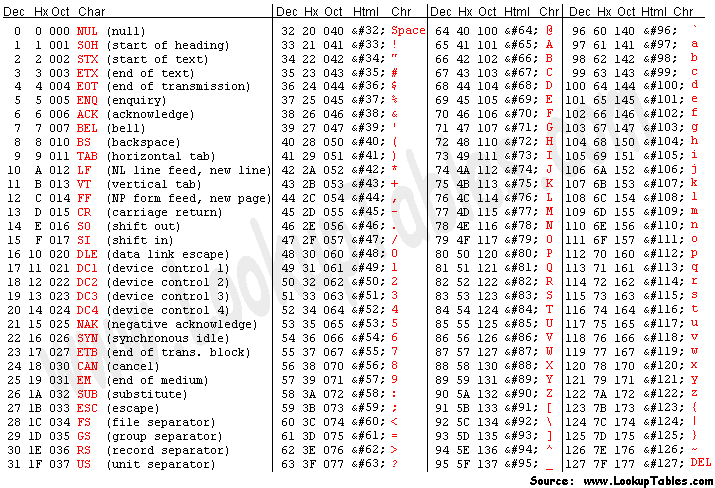
ASCII stands for American Standard Code for Information Interchange. Computers can only understand numbers, so an ASCII code is the numerical representation of a character such as 'a' or '@' or an action of some sort. ASCII was developed a long time ago and now the non-printing characters are rarely used for their original purpose. Below is the ASCII character table and this includes descriptions of the first 32 non-printing characters. ASCII was actually designed for use with teletypes and so the descriptions are somewhat obscure. If someone says they want your CV however in ASCII format, all this means is they want 'plain' text with no formatting such as tabs, bold or underscoring - the raw format that any computer can understand. This is usually so they can easily import the file into their own applications without issues. Notepad.exe creates ASCII text, or in MS Word you can save a file as 'text only'.
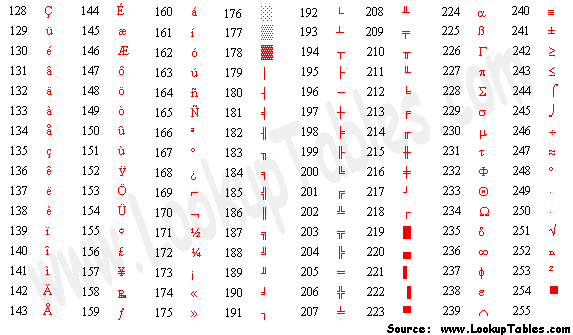
Extended ASCII Codes
History
The American Standards Association (ASA), now the American National Standards Institute (ANSI), began work on ASCII on October 6, 1960. The encoding scheme had origins in the 5-bit telegraph codes invented by Émile Baudot. The committee eventually decided on a 7-bit code for ASCII. 7 bits allow for 128 characters. While only American English characters and symbols were chosen for this encoding set, 7 bits meant minimized costs associated with transmitting this data (as opposed to say, 8 bits).
The first 32 characters of ASCII were reserved control characters. These characters were used to relay special instructions to other devices, like printers. For example, a user could advance a line, delete a character, and more.
ASA published the first version of ASCII in 1963 and revised it in 1967. The last major update to the standard occurred in 1986. ASCII first saw commercial use in the American Telephone & Telegraph (AT&T) TeletypeWriter Exchange (TWX) network.
Other encoding schemes existed at the time, such as the International Telegraph Alphabet No. 2 (ITA2), but ASCII quickly became the standard for American English encoding. ASCII was the most common encoding found on the Internet until it was surpassed by UTF-8 in 2007.