Asymptotic Analysis
Asymptotic Analysis is defined as the big idea that handles the above issues in analyzing algorithms. In Asymptotic Analysis, we evaluate the performance of an algorithm in terms of input size (we don’t measure the actual running time). We calculate, how the time (or space) taken by an algorithm increases with the input size.
Why performance analysis?
There are many important things that should be taken care of, like user-friendliness, modularity, security, maintainability, etc. Why worry about performance? The answer to this is simple, we can have all the above things only if we have performance. So performance is like currency through which we can buy all the above things. Another reason for studying performance is – speed is fun! To summarize, performance == scale. Imagine a text editor that can load 1000 pages, but can spell check 1 page per minute OR an image editor that takes 1 hour to rotate your image 90 degrees left OR … you get it. If a software feature can not cope with the scale of tasks users need to perform – it is as good as dead.
Given two algorithms for a task, how do we find out which one is better?
One naive way of doing this is – to implement both the algorithms and run the two programs on your computer for different inputs and see which one takes less time. There are many problems with this approach for the analysis of algorithms.
- It might be possible that for some inputs, the first algorithm performs better than the second. And for some inputs second performs better.
- It might also be possible that for some inputs, the first algorithm performs better on one machine, and the second works better on another machine for some other inputs.
Asymptotic Analysis is the big idea that handles the above issues in analyzing algorithms. In Asymptotic Analysis, we evaluate the performance of an algorithm in terms of input size (we don’t measure the actual running time). We calculate, how the time (or space) taken by an algorithm increases with the input size.
Asymptotic notations
The main idea of asymptotic analysis is to have a measure of the efficiency of algorithms that don’t depend on machine-specific constants and don’t require algorithms to be implemented and time taken by programs to be compared. Asymptotic notations are mathematical tools to represent the time complexity of algorithms for asymptotic analysis. The following 5 asymptotic notations are mostly used to represent the time complexity of algorithms.
big O notation
he Big O notation defines an upper bound of an algorithm, it bounds a function only from above. (this is the worst case scenario).
to simplify:
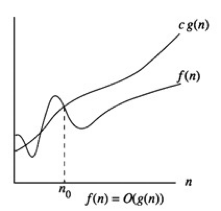
examples:
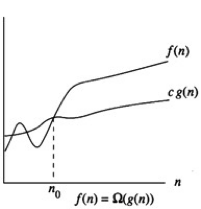
Just as Big O notation provides an asymptotic upper bound on a function, Ω notation provides an asymptotic lower bound.
Ω Notation can be useful when we have a lower bound on the time complexity of an algorithm.
basically this the the best case scenario
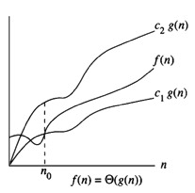
The theta notation bounds a function from above and below, so it defines exact asymptotic behavior.
A simple way to get the Theta notation of an expression is to drop low-order terms and ignore leading constants.
we can define it also like the following :
Little
Big-Ο is used as a tight upper-bound on the growth of an algorithm’s effort (this effort is described by the function f(n)), even though, as written, it can also be a loose upper-bound. “Little-ο” (ο()) notation is used to describe an upper-bound that cannot be tight.
in a math syntax that just means that
Little
The relationship between Big Omega (Ω) and Little Omega (ω) is similar to that of Big-Ο and Little o except that now we are looking at the lower bounds. Little Omega (ω) is a rough estimate of the order of the growth whereas Big Omega (Ω) may represent exact order of growth. We use ω notation to denote a lower bound that is not asymptotically tight.
And, f(n) ∈ ω(g(n)) if and only if g(n) ∈ ο((f(n)).
Using boundaries to define asymptotic notations
if